 Japan’s quiet strength
Things Japan is doing that other countries could learn from
When considering a nation's value to its people, we should ask: How do we define the value people receive from their societies, and do those societies provide happy places to live?
To determine a country's relative strength and its ability to provide value for citizens, experts often consider the country's gross domestic product (GDP). But that single metric is too vague. Measuring GDP alone excludes other important factors, such as safety, quality of life, and foreign direct investment (FDI). It also ignores many other historically important factors that determine whether people derive value from the places they live.
According to Johan Norberg, who has studied the rise and fall of historical empires, societies offer four main values to their citizens, which can explain why some empires rise to power and ultimately collapse. These values are: (see Figure 1)
- Physical mobility (citizens' ability to physically relocate)
- Professional mobility (citizens' ability to enter a wide range of professions)
- Social mobility (citizens' ability to be broadly socially accepted)
- Psychological mobility (citizens' ability to find positive supporters)
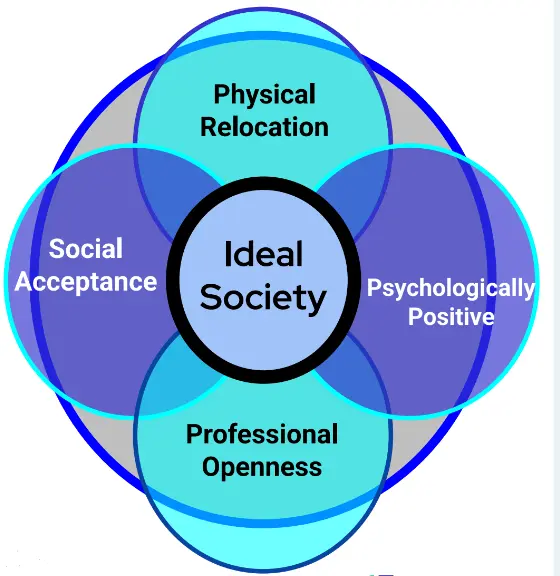
In this article, I'll examine Japan's current social and geopolitical situation and consider how it is performing with respect to the four societal mobility values Norberg identifies. I'll also explain how the Open Organization principles of transparency, adaptability, collaboration, inclusivity, and community have played (and will continue to play) a role in Japan's national progress. Finally, I'll discuss where the country could be heading.
To do this, I'll refer extensively to Ulrike Schaede's book The Business Reinvention of Japan. For some time now, her book has helped me better understand how Japan has evolved. Schaede has also published a new book, Japan Re-Emerges, to which I will also refer. In particular, I want to show how Japan has become what Schaede calls an “aggregate niche society”, and how this evolution is possible because of the mobility values Norberg advances. This involves finding a product buried within supply chains, not the initial raw material nor the finished product intended for consumers.
An incomplete picture
First, let me explain the incomplete picture of Japan and an exclusive focus on GDP.
While Japan is still among the top five largest economies in the world and the No. 1 or No. 2 global technology complexity leader (see Harvard Growth Lab's Country Rankings), its GDP relative to other countries is shrinking. It is now the fourth largest, behind Germany—and in the years ahead, is on track to fall behind India and Indonesia to No. 6. If GDP were the only measure of the country's ability to deliver opportunities to its citizens, the scenario would seem bleak.
But given Japan's overall microeconomic performance and demographics, GDP should be of lesser importance. To help complete our picture of Japan's economic situation, consider the following:
- Japan has consistently ranked high in the Product Complexity Ranking by the Harvard Growth Lab for many years. After years of ranking No. 1, in 2023 Japan was ranked third behind Singapore and Switzerland, which are smaller countries.
- Some Japanese companies produce the world's most important products and hold advanced technical competitiveness. These companies are technology leaders in niche markets with products that are difficult to make and replicate. Furthermore, they are difficult to spot. For example, Keyence (sensors) and FANUC (robotics and factory automation) are highly profitable but difficult to notice. Others are in factory automation, electronics, product components, and advanced chemicals. These products are difficult to assign to one industry. These companies offer the Japanese population the ability to relocate, enter new professions, interact with new societies, and become optimistic.
- The Japanese government is actually promoting a program of slow economic growth to adapt to an aging population.
| Current Strengths | Digital Transformation Opportunities |
|---|---|
| Manufacturing/factory automation | Digital manufacturing |
| Factory automation | Edge computing, Cloud communication |
| Basic chemicals | Advanced chemicals; new difficult-to-make materials |
| Chemicals | Pharmaceuticals (bio/health sciences, CDMO, etc) |
| Fine chemicals for electronics | Advanced input materials (photoresists, films, etc) |
| Glass | Advanced glass substrates, materials, films |
| Textiles | New materials, membranes, etc |
| Precision machinery | Medical equipment, sensors |
| Robotics | Autonomous systems |
| Video/home electronics | Sensors, motors, advanced optics |
| Energy | Renewables, storage, smart grid |
| Trains | Smart cities |
| Communications | 5G infrastructure, smart cities |
| Automobiles | Flying cars, Mobility-as-a-Service solutions |
Exhibit 3. Japan's New Business Opportunities in the Digital Transformationin Ulrike Schaede's book Japan Re-Emerges, chapter 2 page 38.
Figure 2 (above) illustrates Japan's current strengths economically. Moving from these technical strengths to specific products derived from them while avoiding weaknesses is an ideal path forward. Given their background, they are transitioning from assemblers to providers of the materials and components that their competitors cannot yet produce.
In 2024, Ulrike Schaede published Japan Re-Emerges, a book that offers new insights into these and other issues. This book sheds light on how Japan will evolve in the years ahead. Schaede is clear: while some Japanese companies have reinvented themselves, others have not. In this new book, she examines what those companies that have reinvented themselves have done and are doing to build a better future for their organizations.
A formula for Japanese success
For her book, Schaede interviewed CEOs and senior managers from what could be considered the 200 most productive Japanese companies. She asked each of them a prepared set of questions, with the core inquiry, Why are you so profitable?
She identified seven key factors that stood out. They are:
- Profit
- Planning and positioning
- Paranoia (prepare for the worst-case scenario and avoid overdependence on others)
- Parsimony (careful use of funds)
- Public relations (create a positive image to society as a whole)
- People (value the importance of employee's desires, feelings and personal goals)
- Pride (strong employee engagement and proud of what the company achieves)
The Open Organization principles of transparency, adaptability, collaboration, inclusivity, and community sit at the heart of these factors. These companies pursued profits rather than gross sales. They had a clear strategy and collective purpose, were fiercely competitive and efficient, and were highly transparent about their operations. They installed senior managers with vision and forward-looking HR policies, and they asked their employees to get involved and challenge the status quo, which motivated them to collaborate more.
Many companies became what Schaede calls an “ambidextrous organization”. These organizations excel at more than one thing. Sometimes, they explore new business models to develop themselves. At other times, they leverage their current strengths (to generate positive cash flow). They do several things well and adjust as needed. They continually ask themselves what business they are in now and what business they would like to be in in the future. According to Schaede, these companies ask what their current core (exploit) competencies are and how they can extend them into new (explore) businesses with unique, difficult-to-make, and difficult-to-imitate products.
Let me explore in more detail some of these aspects:
Mindset: These ambidextrous Japanese companies have forward-looking technology and a culture that rewards venturing outside existing boundaries. They encourage risk-taking and learning through trial and error. This doesn't happen by accident. These companies must have forward-thinking management that provides active risk taking attention and support. An example of this is Toyota redirecting management's attention into becoming a MaaS (mobility as a service) provider, as they know worldwide total market car sales volume will decline in the years ahead. Another is Fujifilm's management targeting its efforts in becoming a life-science organization. As of March 2023, 32% of its revenues were generated in its healthcare-related businesses, with the remainder coming from office equipment (29%), semiconductor materials (24%), and cameras (14%). When photography was disrupted by the switch to digital, Fujifilm made an aggressive move into digital imaging and fine chemicals.
Discipline: Successful innovation requires a disciplined approach that builds on existing competencies and extends them into new areas. These competencies provide a strategic roadmap that guides extensions of current abilities, which are in line with available technology and shifts in competitors. Forward-thinking companies did not tolerate old habits in this new competency extension, not even among management. This is forcing the realization that adaptability is one of an organization's assets. According to Schaede, it is much easier to change if management focuses on their assets rather than their liabilities.
Social radar: In order to be successful within a community or organization, members must learn how to find a productive role. Initially, they must observe what is appropriate in order to earn the necessary respect. They need a social radar, or the ability to sense what the community wants. People anywhere need social sensing to fit in and adapt to new situations, such as joining a new company, department, or task force. Those in conservative cultures tend to have a more sensitive social radar. However, even in the loosest cultures, there are norms that people must learn and use to be productive and respected.
A focus on culture
So far, I've argued for downplaying the importance of GDP figures and emphasizing organizational culture in an analysis of Japan's current economic situation. A company's culture is defined by the behaviors it considers normal. If Japanese businesses plan to survive, their normal way of thinking must change, and different strategies require different ways of thinking. In short, corporate culture must be managed.
In this section, then, I'll explain some facets of Japanese organizational culture and the role open organizational principles can play in them:
In Japan, deviant behavior is often called out. Subtle enforcement mechanisms include shaming or casting a skeptical glance. More rigorous enforcement can come in the form of ostracism, cruel bullying, or severe punishment. In her own work, Schaede references Michele Gelfand's insight that Japan values behaviors associated with “tight cultures” more than most Western nations do. This is why social pressure is far more powerful than religion, laws, or official rules.
Some Japanese companies are embracing these norms to drive their organizations forward into new products and markets. However, many Japanese employees are secretly using cultural norms to slow down or stop progress for their own self-interest. Schaede writes about three areas where these norms are especially salient: politeness, appropriateness, and inconvenience. Let me discuss each one:
1. Being Polite
Japan places a high value on politeness compared to other societies. While this can make people feel good, it can also cause people to be less honest. Even in my Japanese family, I notice members being overly polite, possibly hiding something. At large family gatherings, this makes everyone uncomfortable because open discussion is limited. Everyone puts on a false front to avoid direct conflict. There is no conflict, nor any in-depth discussion. In smaller gatherings, however, this politeness is reduced, leading to more information exchange. I have had to have many private discussions in bars after work to learn about concerns and get information so that projects can move forward.
This politeness can hinder in-depth discussions at best and cause communication breakdowns at worst. Out-of-the-office meetings in bars and quiet one-on-one discussions are common in almost all Japanese companies. If you have just joined a company, it will take several years to develop relationships to the point where these casual discussions can be productive.
The agreements reached in most formal meetings are the result of informal discussions. Whether within a company, among a company's stakeholders, within a community, throughout a country, or between nations, building respected and trusted relationships that provide transparency is critical, though challenging. The Japanese tend to be pretty good at it, and the rest of the world could learn from them.
2. Be appropriate
Depending on the setting, everyone must dress and behave in a way that is appropriate. Most Japanese companies have uniforms. Standing out and drawing attention to oneself may be perceived as offensive. Therefore, silence and careful listening are common as people struggle to determine what is appropriate. This silence limits transparency.
3. Don't inconvenience anyone
There is always a worry about embarrassing others or asking them to do something they hadn't planned on doing. Some people even fear going on vacation because it might create extra work for others. For another example, in a Japanese office, the first person to leave at the end of the day is often uncomfortable, as others must continue working. There is a Japanese word that directly translates into I'm being rude,
when someone leaves the office.
Examining those three Japanese cultural norms at their most extreme, it's highly unlikely that any change would be possible, no matter how productive. According to Schaede, one must make noise and make others slightly uncomfortable with the status quo to effect change. She recommends slowly working on two of the three norms to get things going. For instance, a person might be perceived as strange but is tolerated, as long as he is polite, respectful and not too pushy. To some Japanese people, this shows their humanity, which is viewed positively.
Throughout my career at Japanese companies, I have found that introducing change is similar to starting new projects. I wrote about this in my article, 5 steps to drive changes on your project. These steps have worked for me, and I believe they could be equally effective in moving companies forward.
The LEASH model
Schaede believes that the norms and patterns of behavior within a company are created by senior management. Therefore, senior management can also improve these behaviors. She recommends the five-step procedure created by Charles O'Reilly: Leadership, Employee Involvement, Aligned Rewards, Stories and Symbols, HR System Alignment (or, “LEASH”)
- Leadership: First, management must develop a plan. Then, they must set an example to execute the plan. They should regularly promote the new plan. They should not remain silent about it. These leaders must also be willing to quit their jobs if they cannot achieve the plan. Those who want to maintain the status quo should also be willing to quit if they do not agree with the plan. Those who resist the plan cannot remain and continue to undermine it. Staff must be persuaded that the new plan will benefit them. It can't just be forced on them.
- Employee Involvement: A work environment should be created that allows frontline employees to participate actively and directly. With solid reasoning and information, they can voice their concerns and worries.
- Aligned Rewards: People who come up with new, attractive, and possibly disruptive ideas to the status quo should be praised. Employees should be able to challenge their superiors on issues they disagree with, backed up by solid sources. Effort should be rewarded.
- Stories and Symbols: Even the smallest success story should be presented and amplified to help everyone visualize a bright, progressive future. They could create a new company brand with a new logo. For example, Asahi Glass changed its name to AGC Inc. to move away from its basic glass image.
- HR System Alignment: HR should ensure that they find the right talent, skills, and desires to match the plans that have been decided upon and remove those who do not possess them. This requires careful candidate selection, new employee training, competitive pay, and promotional opportunities to encourage new ways of thinking and working.
Japanese government involvement
Moving into entirely new, highly disruptive products requires a significant amount of risk-taking. This is especially true for “deep tech” research. These projects tackle substantial scientific and engineering challenges and may take up to ten years to produce results. However, they will be extremely difficult to copy or produce elsewhere.
That is where governments must play a role. Japan's culture of tight, long-term thinking is supporting and connecting project partners like never before. These collaborations reduce risks and improve the efficiency in product development. We saw this during the global outbreak of the novel coronavirus, when governments brought competitors together to develop vaccines.
Japan's Future Business Strategy
At the strategic level, Japan may not benefit from following Silicon Valley's highly competitive model, as the costs to society and human well-being could be too high. Japan's tight culture seems to prefer a model that provides stability and predictability to society. For example, Japan's general understanding of success might be a positive cash flow and stable employment growth.
A better business strategy is presented throughout Schaede's book. The Open Organization principles of transparency, adaptability, collaboration, inclusivity, and community are critical to this strategy. These strategies will promote corporate prosperity and provide society and its citizens with the ability to relocate, enter a wide range of professions, be socially accepted, and find positive work environments, as I presented at the beginning of this article.
Simply, I think that Schaede believes Japan must function within its tight cultural setting as well as its industrial, financial, and societal norms. It cannot simply adopt another culture's business model. Japan needs to consider the tradeoffs between speed and stability, as well as between financial gains and personal meaning.
According to Schaede, within this tight Japanese cultural environment, innovative ideas must be generated at four levels:
- Within large firms, such as exiting unprofitable operations through spinoffs and entering other firms through acquisitions.
- Among startups with new product ideas.
- Through venture capital-supported projects, which could open new corporate R&D processes and expand global connections.
- Through overall employment reform, such as hiring more mid-career professionals, dispatching employees to other companies for experience, and bringing in more foreign engineers.
Despite stagnation, Japan has been progressing steadily over the past 30 years. Its unemployment rate is much lower than that of all other OECD countries. People work hard and conscientiously, and those without high skills can find part-time work. Japanese society is orderly, and there are no major social disruptions. The social safety net is robust, the country is beautiful, and the cities are clean and safe. In addition to that, the society offers its people the ability to physically relocate when desired and need be. Their people have the potential to enter a wide range of professions. Different people are generally, widely socially accepted. And, the overall environment is positive and supportive. Therefore, quiet, steady, slow, and stable reform suits Japan.

Ron McFarland has been working in Japan for over 40 years, and he's spent more than 30 of them in international sales, sales management training, and expanding sales worldwide. He's worked in or been to more than 80 countries. | LinkedIn